

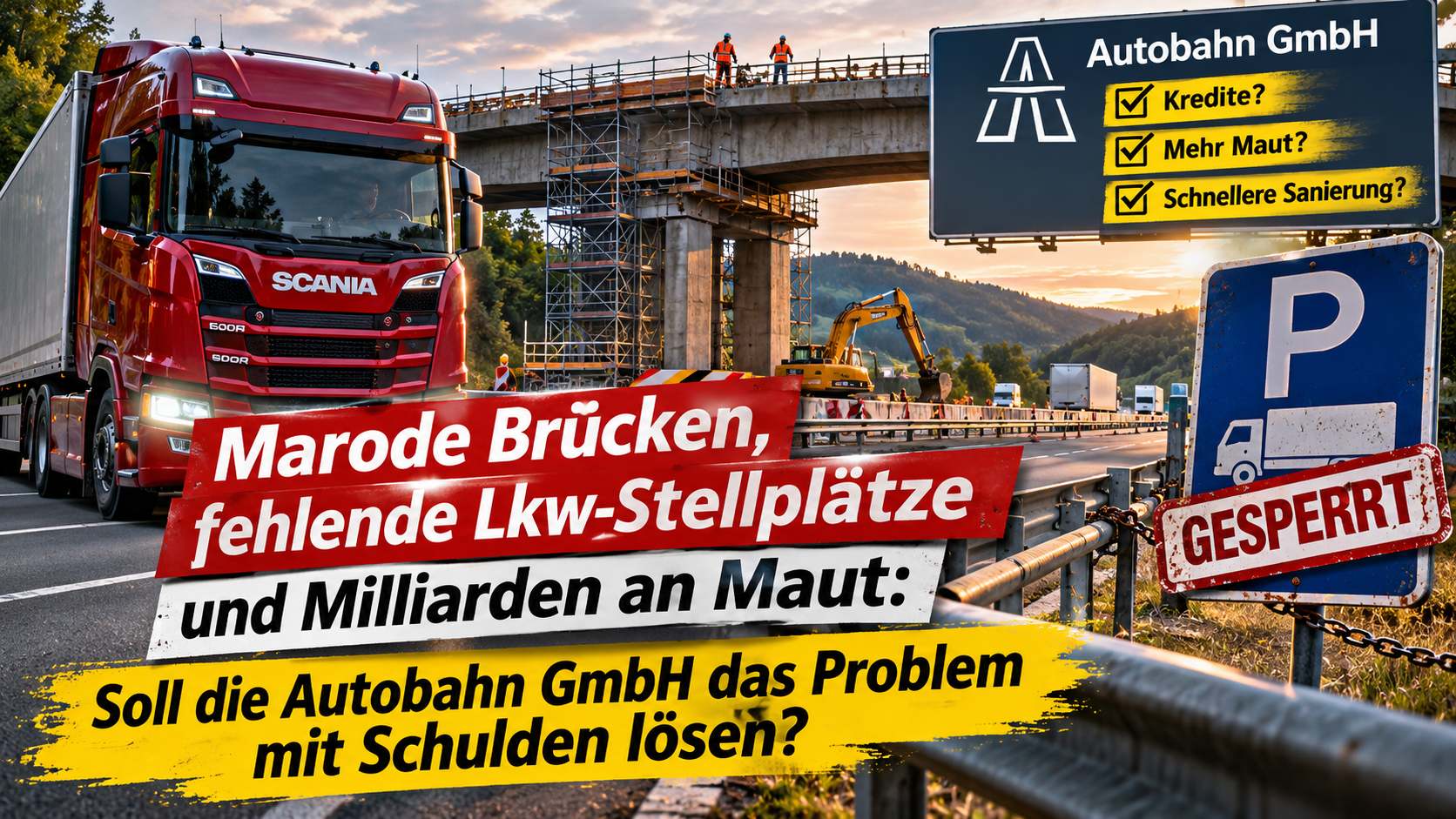
Dilapidated motorway bridges, rest areas closed for years, and thousands of missing truck parking spaces nationwide. Germany’s road infrastructure has significant deficits, the consequences of which the transport industry feels every day.
The federal government now wants to fundamentally change the financing of the Federal Motorway Company. In the future, the state-owned company should be able to take out loans itself, issue bonds, and directly manage part of the truck toll revenues.
On 23 November 2026, the Transport Committee of the German Bundestag dealt with the corresponding draft law in a public hearing. It became clear that the ideas about the future financing of the motorway infrastructure differ considerably.
While in Berlin discussions are taking place about creditworthiness, financing costs, and the debt brake, I, as a professional driver, ask a much more practical question: Will dilapidated bridges finally be replaced more quickly and will sufficient safe truck parking spaces be created as a result?
The Autobahn GmbH shall be permitted to take out loans itself
Since January 1, 2021, the Autobahn GmbH des Bundes has been responsible for the planning, construction, operation, and maintenance of the federal motorways.
Until now, its financing has been provided through the federal budget. Consequently, the company is dependent on the respective budget decisions of the federal government.
With the Infrastructure Company Financing Amendment Act, Bundestag document 21/8868, the federal government aims to reduce this dependency.
Future financing is to be based on budget funds, own revenues from the truck toll, and the raising of external capital.
From 2027 onwards, the Autobahn GmbH shall be able to take out loans and issue bonds. From January 1, 2028, the infrastructure share of the truck toll on federal motorways and federal roads under federal administration shall flow directly to it.
According to the Federal Ministry of Transport and Digital Infrastructure, this currently amounts to approximately 4.5 billion euros annually.
These revenues are to be used, among other things, to repay the loans taken out, including the accruing interest.
Privatization of the motorways is not provided for in the draft bill. Both the motorways and the Autobahn GmbH are to remain fully owned by the Federal Government.
Budget funds have already been cut
It is noteworthy that the planned financing reform is already reflected in the federal budget for 2027, even though the corresponding law has not yet been passed.
The Budget Committee of the German Bundestag has significantly reduced the originally planned investment funds for the Autobahn GmbH in the regular federal budget.
| Investment approach for 2027 | Amount |
|---|---|
| Original government draft | 4.36 billion euros |
| After the decision of the Budget Committee | 2.38 billion euros |
| Difference | 1.98 billion euros |
In addition, the originally planned commitment authorizations in the amount of 5.51 billion euros were completely cancelled.
These authorizations would have allowed entering into financial commitments for investments in the coming budget years as early as today.
According to the Bundestag, the cuts are explicitly linked to the planned restructuring of highway financing.
This does not necessarily mean that total investments in highway infrastructure will decrease by the same amount. However, it shows that borrowing is at least partially planned to replace previously provided budget funds.
This should actually create additional financial room for the Autobahn GmbH.
Federal Audit Office warns of higher costs
The Federal Audit Office views the planned restructuring critically.
Its Vice President Klara Geywitz explained during the public hearing that while the proposed financing model could temporarily close investment gaps, higher costs would arise in the long term.
Traffic infrastructure economist Professor Thorsten Beckers from the Bauhaus University Weimar also expressed significant concerns.
The background is relatively simple: The Federal Republic of Germany has a high credit rating and can finance itself at comparatively favorable terms on the capital market.
Higher financing costs could arise for an Autobahn GmbH that takes on credit independently. The draft bill explicitly rules out state security for its loans through guarantees or bonds.
Even regarding the debt brake, the experts’ assessments diverged.
While Beckers and the infrastructure law specialist Georg Hermes assessed the construction as a circumvention of the debt rule, constitutional law expert Stefan Korioth held a different view.
Regardless of this constitutional law discussion, the economic question remains: Why should the state finance its motorways through a potentially more expensive loan if it has access to cheaper financing options itself?
The construction industry is already missing two billion euros today
Tim-Oliver Müller, Managing Director of the Main Association of the German Construction Industry, estimated the existing financing gap of the Autobahn GmbH during the hearing at around two billion euros.
Without a timely decision on the future financing, a tender stop threatens his assessment.
For construction companies, a lack of planning security means they cannot reliably plan personnel, machinery, and other capacities for future projects.
For this reason, the construction industry called for a permanently secured basic funding from the federal budget. Loans should complement this financing, not replace it.
A tender stop would be the last thing Germany’s motorways could use, given the considerable renovation needs anyway.
Decaying bridges: The A45 shows the extent of the problem
Anyone who regularly travels on the Sauerland line does not need extensive reports to recognize the need for repairs to Germany’s highway infrastructure.
Alone between Dortmund and Giessen, a total of 60 large bridges of the A45 must be replaced by new constructions. Of these, 38 are in North Rhine-Westphalia and 22 in Hesse.
A significant part of these structures dates from a time when neither today’s traffic volume nor the now usual loads from heavy goods traffic were foreseeable.
What the failure of a single highway bridge can entail has impressively been shown by the multi-year closure of the A45 at Lüdenscheid.
For transport companies, such closures mean not only longer driving distances. They lead to additional fuel consumption, higher personnel costs, more difficult route planning and, where applicable, additional toll costs on diversion routes.
Even where bridges can still be crossed, speed limits, weight limits and roadworks lead to restrictions.
I have already reported in more detail on the condition of the Sauerland line and the ongoing bridge renewals:
A45: Dilapidated bridges and the long renewal
A reliable financing secured over several years could indeed help implement such projects more quickly. However, sufficient planning capacities, permits, and construction companies must also be available for this.
The ability to take out loans alone does not accelerate bridge construction.
Truck parking spaces: A problem known for decades
While the renovation of dilapidated bridges is now regularly the subject of political discussions, another problem often receives less attention: the shortage of truck parking spaces.
The figures from the Federal Agency for Road and Traffic speak for themselves.
| Survey year | Missing truck parking spaces |
|---|---|
| 2018 | around 23,400 |
| 2023 | around 19,600 |
Within five years, the identified deficit could thus be reduced by around 3,800 parking spaces.
This is an improvement. However, given the continuing shortage, this pace is by no means sufficient.
The figure of 19,600 missing parking spaces also comes from the 2023 survey. It is not an up-to-date inventory for the year 2026.
Anyone who regularly travels on Germany’s motorways knows, however, that the problem has by no means been solved.
On heavily frequented motorway sections, the parking spaces begin to fill up partially as early as the afternoon. Anyone who can only start their daily rest period in the evening often has difficulty finding a suitable parking space at all.
When existing parking spaces are also closed
The construction of additional truck parking spaces is only one side of the problem. The other is the loss of existing parking facilities.
The A45 provides a concrete example for this as well.
Since July 6, 2025, the two highway parking lots Pfahlgraben and Hardt-Wald near the Gambacher Kreuz have been closed.
In response to my press inquiry on November 3, 2026, the Autobahn GmbH informed me that a total of around 16 truck parking spaces have been lost as a result.
Significant structural defects were cited as reasons, among others. A renovation would be economically little sensible given the planned relocation of the parking lots in the context of the six-lane highway expansion.
I can fully follow this argumentation from the perspective of long-term construction planning. However, no specific date was given to me by which the lost parking facilities will be available again.
For professional drivers, it is irrelevant whether a more modern rest area is to be created at this location in a few years. The parking spaces are missing today.
I have published the full background on the two closed parking lots here:
A45: Two truck parking spaces closed for over a year – and there is no end in sight
There is also another observation from everyday driving: parking areas are not only made unusable due to construction work or structural defects. Sometimes road authorities also use them for temporary storage of sweeping debris from road cleaning or green waste resulting from the maintenance of road edges. If parking spaces are blocked off or covered with such material, they are also temporarily unavailable for the mandatory breaks and rest periods.
That cleaning and landscaping are necessary is beyond question. However, the storage areas required for these purposes should be organized in such a way that the already scarce truck parking space remains available as much as possible. Where a temporary closure is unavoidable, there needs to be a clear time limit and information about alternative options. But that is usually the difference between theory and practice. Most often, such waste blocks a parking space for months.
Especially with larger highway projects, it should therefore not only be considered how many new parking spaces will be created after the completion of the construction work. Equally important is the question of which parking options are available during the partly multi-year construction period.
The shortage of parking spaces is a road safety problem
The statutory driving and rest periods were not introduced to employ professional drivers or to create additional administrative burdens for transport companies.
They serve road safety.
For a professional driver to be able to comply with the mandatory rest periods, however, he needs a suitable and above all safe parking space.
Exactly here a contradiction arises between legal requirements and the infrastructure actually available.
We are expected to plan our trips so that we reach a parking lot in time. Yet it is hardly possible to reliably estimate several hours in advance whether a suitable parking space will be available at a certain rest area at the planned time.
A roadworks site, an accident, or an unexpectedly long wait time during loading or unloading can additionally change the entire trip planning.
Of course, the lack of parking spaces does not justify parking vehicles dangerously in entry and exit lanes or on the shoulder. Nevertheless, the causes of this behaviour cannot be ignored permanently.
The fact that passenger cars collide with illegally parked trucks in the dark shows how serious the consequences can be.
The expansion of truck parking spaces is therefore not a comfort measure for professional drivers. It is an investment in the safety of all road users.
Digital parking guidance systems do not replace parking spaces
In addition to classic new construction and expansion, the Autobahn GmbH also relies on digital parking guidance systems and a more efficient use of existing rest areas.
An example of this is telematic parking, where several trucks are parked one after another according to their planned departure time.
Such systems can certainly be useful. They allow existing areas to be utilized better and additional parking options to be created with comparatively low construction effort.
Digital displays of available parking spaces can also reduce unnecessary search traffic. A concrete example is the Parking Space Information Service (SID) of the Federal Ministry of Transport and Toll Collect. It provides near real-time information on the occupancy of truck parking facilities at highway service areas. Drivers and dispatchers can thus better assess which service area is suitable for the next break.
We also use this data in our EcoMove map . There, truck parking facilities and the respective SID occupancy information available can be viewed on a map. This can facilitate the search for a suitable rest stop and the planning of driving and rest periods.
However, the figures are not a guarantee of an available parking space upon arrival. According to Toll Collect, the utilization is derived from data from the toll system and statistical methods; individual free parking spaces are not recorded directly. Delays, roadworks, or otherwise occupied areas can therefore lead to deviations. In EcoMove, the displayed data status should also be observed.
However, a parking guidance system cannot indicate a free parking space if none are available along the entire route.
Digital solutions can support expansion. They cannot replace it.
Billions in toll revenues – and yet there is still no money
For the fiscal year 2027, the federal government calculates revenues from the truck toll at around 13.2 billion euros.
However, this is not exclusively revenue for road infrastructure. The truck toll now includes costs for air pollution, noise pollution, and CO₂-emissions.
In addition, part of the toll revenues is used for financing rail infrastructure.
With the planned reform, the Autobahn GmbH will be able to directly manage its entitled infrastructure share in the future.
This can generally be sensible. A direct source of revenue could reduce dependence on annual budget decisions.
However, interest and principal repayments for taken loans will also be financed from these revenues in the future.
This raises the question of what share of toll revenues will actually be available for construction, operation, and maintenance of the road infrastructure in the long term.
If investments urgently needed today are accelerated, loan financing can be economically sensible. If, however, permanently missing budget funds are replaced by ever new loans, there is a risk that financial room for manoeuvre will increasingly be restricted in later years.
Given the current court ruling on the partially unlawful calculation of the truck toll between 2016 and 2020, the future use of toll revenues should also be made particularly transparent.
Is the transport industry facing the next toll increase?
A concrete increase in the truck toll is not provided for in the present draft bill.
It would therefore be wrong to claim at this point that the reform will inevitably lead to higher toll rates.
Nevertheless, the question arises how the Autobahn GmbH is to finance rising construction costs, ongoing operating expenses, and debt service in the long term if the revenues available to it are insufficient.
The options would be limited: additional budget funds for its other tasks, cost-cutting, reduced investments, or higher or additional revenues.
The Federal Audit Office already pointed this out during the hearing, stating that the Autobahn GmbH might need further revenue sources in the long term.
An additional burden on the transport industry would at least be a conceivable political option. Whether a corresponding increase would be permissible under EU law would have to be examined based on the respective toll regulations.
Austria as a possible model?
Herbert Kasser, CFO of the Austrian ASFINAG, was also present at the hearing.
Austria has had a model for many years in which the motorway and expressway infrastructure is financed largely through user fees.
However, there is a significant difference with Germany.
In Austria, car drivers also contribute directly to the financing of motorways and expressways via vignettes and, where applicable, additional tolls. In Germany, there is no comparable general car motorway toll.
Therefore, transferring individual elements of the Austrian financing model to Germany does not automatically mean that its financing options and economic results can also be transferred.
However, the introduction of a general car toll is not the subject of the current draft bill.
What the financing reform must be measured against
Whether the planned re-regulation actually represents an improvement should, in my view, not be assessed solely on the basis of the Autobahn GmbH’s creditworthiness.
What ultimately matters is what arrives on the road.
For me, this includes in particular:
- A reliable basic funding from the federal budget that is not replaced by loans.
- A binding and publicly verifiable investment program for dilapidated motorway bridges.
- A concrete timetable for eliminating the nationwide shortage of truck parking spaces.
- The creation of temporary replacement parking spaces in the event of long-term closures of existing service areas.
- A transparent breakdown of the use of toll revenues, in particular the financing costs that will arise in the future.
- Regular publication of the truck parking spaces actually created, temporarily closed, and permanently removed.
Especially the last point is important. If a new service area receives additional parking spaces while existing parking spaces are closed at another location, the number of newly created parking spaces alone says little about the actual improvement of the parking situation.
My conclusion
That the Autobahn GmbH requires a reliable long-term financing is, in my view, beyond any doubt.
Bridges cannot be planned and replaced within a single budget year. Building a rest area often requires several years of lead time.
The option to take out loans can therefore be a sensible instrument. However, it becomes problematic if the federal government simultaneously reduces its regular financing commitments and forces the Autobahn GmbH to fill these gaps with loans.
In that case, the problem might merely be postponed into the future and made more expensive through additional financing costs.
Anyone spending many hours on Germany’s autobahns does not need a new financing architecture for its own sake. They need a functioning road infrastructure.
This includes reliable bridges, reasonably drivable autobahns, and sufficiently safe parking facilities.
Whether the planned reform will actually improve these prerequisites remains to be seen.
The political authorities should certainly not be content with merely opening up new possibilities for the Autobahn GmbH to take out loans. They must also ensure that concrete and measurable improvements for road users result from this.
Sources and further information
German Bundestag – Bill to amend the financing of the infrastructure company, Drucksache 21/8868
German Bundestag – New financing model for the Autobahn GmbH controversial
German Bundestag – Budget 2027: Transport budget drops significantly
Federal Ministry of Transport – New financing structure for the Autobahn
Autobahn GmbH – Expansion of the A45 between Dortmund and Gießen
Federal Ministry of Transport – Truck parking space information service (SID)
As of: 27 November 2026. The legislative procedure is not yet complete.