

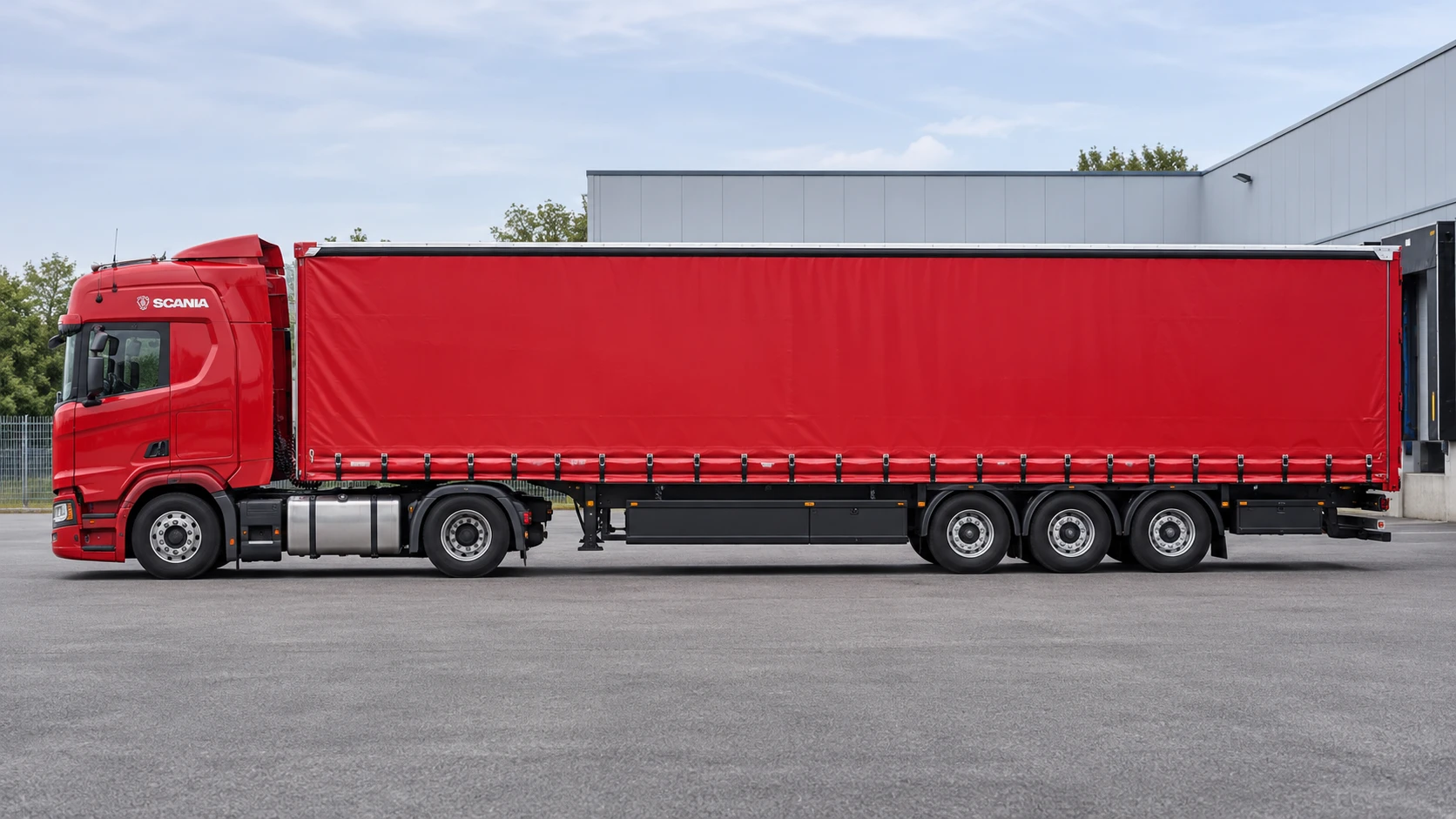
More space for the cab and seven more years for the extended semi-trailer: Since November 21, 2026, the 14th Long-Truck Amendment Regulation applies. For drivers and dispatch, it depends on the specific combination. The new length limit of 18.41 meters applies exclusively to Type 1 with a two-axle tractor unit and a correspondingly extended cab.
The regulation bears the date November 18 and was published in the Federal Law Gazette on November 20. Article 2 stipulates the entry into force on the following day. What matters is the promulgated version in the Federal Law Gazette, Part I No. 345 ; the BGBl.-original text is also available as a PDF at Buzer .
18.41 meters: The additional space belongs to the cab
Type 1 is the combination of semi-trailer tractor and semi-trailer. 17.88 meters overall length remains in place. New is the exception up to 18.41 meters, if the excess is caused exclusively by an extended cab according to Annex XIII of Implementing Regulation (EU) 2021/535. The tractor must be two-axle. The load capacity must not increase with this equipment. This is stated in Section 4 Paragraph 1 of the updated exception regulation .
For everyday life, this means: Before swapping the tractor, looking at the trailer is not enough. The actually resulting overall length, the number of axles of the tractor, and the conditions for the cab exception must be checked. A three-axle tractor does not fall under this new special regulation.
The Federal Ministry of Transport lists as possible advantages better aerodynamics, cheaper direct visibility, and more driver comfort. How much of this reaches the workplace depends on the respective vehicle. Additional external length alone does not yet describe the usable space in the cab.
52 or 53 centimeters?
In the present DVZ social media teaser for the announcement ‘Long trucks: BMV allows extended cab’, 52 centimeters are mentioned. 18.41 minus 17.88 meters = 0.53 meters, i.e., 53 centimeters. Why the teaser mentions 52 centimeters cannot be determined from this. For operational planning, the total length stipulated in the law counts; it is not a blanket approval to extend every Type 1 by this amount.
Until the end of 2033 – continued trial
The regulations for Type 1, which were previously set to expire at the end of 2026, now apply until 31 December 2033. Section 13 of the regulation contains the new deadline. A permanent transition to regular operation is still not the case. The BMV explicitly designates the use of Type 1 as a traffic trial; Types 2 to 5 are already in continuous operation on specific routes.
For companies, this creates a longer planning horizon. Those procuring vehicles must still take the renewed fixed-term into account. The reporting obligation remains relevant: In the event of accidents or difficulties with the drivability of routes and traffic facilities with Type 1, the transport company must inform the BASt. § 12 requires details on location, time, and cause as well as a brief description. Drivers should document such incidents accordingly and pass them on within the company.
Berlin opens up for Type 1, the positive network expands
Type 1 may, under the new Section 2 Paragraph 2 use the entire road network of all countries. The previous Berlin exception is thus abolished. Local signage and other traffic restrictions must still be observed.
For types 2 to 5, the positive network remains crucial. After BMV information on the new regulation around 115 route sections are added. This is not a blanket approval. The approach to the customer and any possible diversion must match the permitted route. § 10 requires for these types, before departure, a check for closures and diversions that would lead out of the approved network.
Caution with older maps: The BMV information page on long trucks still refers at the time of research to a map with the status of the 13th amendment. The current annex to the regulation is decisive.
More length does not mean higher weights
The amendment does not increase the permissible weights. The BMV continues to cite 40 tonnes or 44 tonnes in combined transport . The higher value requires that the conditions of the respective transport are met; it does not apply automatically to every long-haul truck.
For drivers, therefore, checking the total mass and axle loads remains just as necessary as before. More space on the trailer does not lift a weight limit. And the new cab exception may not create additional loading capacity anyway.
What the BGL furthermore demands
German Freight and Logistics Association welcomed in its statement of 31 July 2026 on the draft the network expansion, the Berlin approval, and the extension until 2033. His demands went even further:
- Extended driver’s cabs should be taken into account for all long-haul truck types, without crediting their additional length against the respective maximum length.
- The conformity certificate should become simpler: for Type 1 also via an entry in the registration documents, in addition with digitally carried certificates for all types.
- Type 1 should be taken into account in bilateral agreements with neighboring states such as the Netherlands and Denmark.
- Packaged hazardous goods should also be allowed to be transported with long-haul trucks.
- Type 1 should be included in European Directive 96/53/EG.
These are association demands from the legislative procedure. The final driver’s cab regulation remains limited to two-axle tractor units for Type 1. The amendment changes neither the regulations for the conformity certificate nor the load rules. Therefore, no permission can be derived from the statement to carry certificates only digitally or to take on additional hazardous goods transports.
What counts before the next tour
Practically, the change brings more selection of suitable tractor units, a longer trial period, and additional usable roads. Before departure, concrete questions remain: Does the coupled combination fit the length limit? Are the required certificates available? Is the planned route permissible for this type? And does the load remain within the weight and load regulations?
The general classification of vehicle types is also covered in our contribution Long trucks and the wrong turns of German bureaucracy . There, the information on the Berlin exception and the deadline end 2026 still describes the then-current status. For these points, the new regulation presented here applies since November 21.
Research date: 24 November 2026. The basis is the announced regulation, the current BMV information, and the explicitly designated items as such. BGL-statement on the draft.