Two of Germany’s best-known parcel carriers want to join forces. The planned combination of GLS and DPD would create a business delivering more than 700 million parcels a year. While the companies talk about efficiency, innovation and better service, millions of recipients face a much more practical question: will deliveries actually improve? And what will happen to existing delivery arrangements, particularly the lack of regular Saturday deliveries at GLS?
Two competitors become one parcel carrier
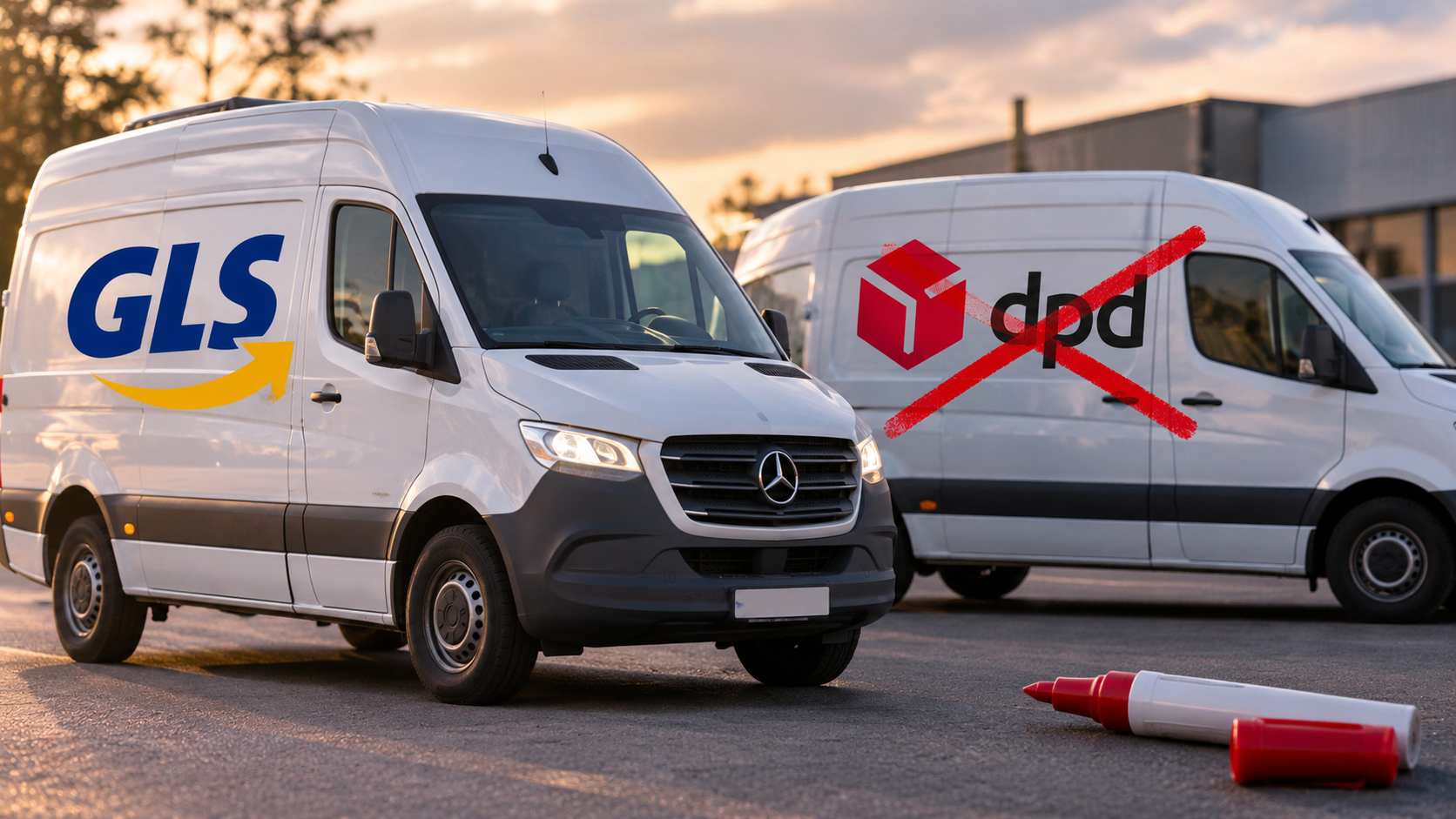
On 18 November 2026, GLS Group and Geopost, DPD’s parent company, announced plans to combine their German parcel operations. Both businesses would operate under one roof. The DPD brand is set to disappear in Germany, with the combined business trading as GLS instead.
The plan is to establish a joint venture in which the GLS side would hold 80 per cent and Geopost 20 per cent. Together, the two parcel carriers would generate annual revenue of more than €4 billion and handle over 700 million parcels a year.
With around 150 sites and some 15,000 employees, the combined company would be a major player in the German parcel market. According to media reports, its market share could reach around 20 per cent.
However, the merger has not yet been finalised. It first needs approval from the relevant competition authorities. The required employee consultation procedures also remain outstanding. Until then, GLS and DPD will continue to operate independently.
€500 million for a shared parcel network
The business case behind the merger is understandable. Two parcel carriers that sometimes drive along the same streets, serve the same towns and perhaps even stop at the same customer’s door can save substantial costs by sharing a delivery network.
The companies intend to invest more than €500 million over the coming years. The money is earmarked for areas including digitalisation, infrastructure expansion and more efficient delivery processes.
GLS chief Karl Pfaff expects the combination of the networks to reduce distances between delivery stops by 20 to 30 per cent. That could save fuel and driving time while also reducing unnecessary journeys.
Another priority is parcel shops and lockers. GLS and DPD have been working together in this area since October 2024. In March 2026, they introduced “inboxx”, a joint brand for parcel lockers open to multiple carriers.
By the end of 2030, their combined network of parcel shops and lockers is intended to grow to around 25,000 locations.
That could bring real benefits for customers, particularly if parcels can be collected or dropped off at more locations without depending on the opening hours of an individual parcel shop.
However, more collection points do not automatically mean better doorstep delivery.
GLS and Saturday deliveries: a problem for working people
While other parcel carriers also deliver standard parcels on Saturdays, GLS Germany does not currently include this in its regular service.
Section 3.1 of GLS’s general terms and conditions explicitly states that regular deliveries take place on working days excluding Saturdays.
GLS does offer a service called SaturdayService, but this is part of its express offering for business customers. It allows parcels to be sent with guaranteed Saturday delivery before 10 am or midday.
For the ordinary recipient, this means that anyone expecting a standard GLS parcel cannot simply count on a Saturday delivery.
That is a disadvantage for many working people. Those who work Monday to Friday and are away from home during the day often only have the opportunity to receive parcels in person at the weekend.
There are, of course, alternatives: authorising parcels to be left in a safe place, using parcel shops or collecting from lockers. But not everyone wants an expensive purchase left unattended outside their front door. Nor does everyone have a suitable parcel locker nearby.
Another factor is that the online retailer often chooses the carrier. Customers may be able to decide where they shop, but not necessarily who delivers their order.
Regular Saturday deliveries would therefore be a meaningful improvement for many consumers.
Will the merger change that?
For now, that question remains unanswered.
The announcements about the merger repeatedly refer to better service quality, greater flexibility and additional delivery options. However, they contain no specific announcement of plans to deliver standard parcels on Saturdays.
DPD also offers a separate Saturday express delivery service in Germany. Under its DPD 12:00 service, parcels collected on a Friday can be delivered by midday on Saturday. This does not amount to a general Saturday delivery service for all standard parcels.
There is therefore currently no reason to assume that the merger will automatically bring regular Saturday deliveries.
It would, however, be an obvious opportunity to review the existing delivery arrangements. If depots, vehicles, IT systems and delivery areas are being reorganised anyway, the delivery times on offer could also be reconsidered.
Whether those responsible actually intend to take that step remains unclear.
Less competition, but more choice?
Another point deserves attention: the merger would remove a previously independent competitor from the German parcel market.
For the two companies, this means a stronger market position. For consumers and online retailers, it initially means fewer independent providers.
The combined business could, of course, use its scale to compete more effectively with DHL, Hermes and Amazon. A denser network can reduce costs and speed up deliveries.
At the same time, there is the question of how reduced competition might affect shipping prices and service conditions in the long term.
Combining two providers’ capacity does not automatically lead to lower prices for customers. The savings could just as easily be used to improve the company’s own profit margin.
The companies’ different financial starting points are also interesting. While GLS Germany made a net profit of around €77 million in the 2024/25 financial year, DPD Germany recorded a loss of approximately €104 million in 2024.
The merger is therefore more than a growth strategy. It could also help put DPD’s financially troubled German business on a more profitable footing in the long term.
What does the merger mean for delivery drivers?
Amid all the discussion of market shares and new parcel lockers, one group should not be forgotten: the people who deliver the parcels every day.
Combining two delivery networks will inevitably change route planning and vehicle utilisation.
Shorter distances between stops can make the job easier. At the same time, they also allow companies to deliver more parcels within the same working hours.
Whether this actually eases the pressure on drivers or simply increases the number of deliveries per round will depend on how the new operation is organised.
There are also questions about existing employment arrangements and the many subcontractors working in the parcel sector.
What happens, for example, when two previously separate delivery areas are served by a single depot? Will the existing drivers be retained? Will transport contractors’ agreements change? And how will the savings be shared between the companies commissioning the work and those carrying it out?
GLS chief Karl Pfaff has said that the merger need not necessarily involve job cuts. However, that does not constitute a binding guarantee of continued employment.
This is one area where it remains to be seen whether employees will also benefit from the promised efficiency gains.
Doorstep delivery could become less central over time
One particularly interesting aspect of the merger is the growing emphasis on parcel shops and lockers.
For parcel carriers, delivery to a central collection point is financially attractive. Rather than visiting numerous individual households, they can drop off several parcels at a single location.
This model can also make environmental sense, particularly when recipients collect their parcels on foot or by bicycle.
For consumers, however, it can mean extra effort. Anyone who has to drive several kilometres to collect a parcel will not necessarily save either time or emissions.
In an interview with Handelsblatt, GLS chief Karl Pfaff described doorstep delivery as a premium service. He also said that its higher costs were already reflected in the prices charged to senders.
That raises a fundamental question: is the parcel industry gradually moving towards treating delivery to the front door as a special service, while collection from lockers becomes the preferred standard?
No such change has been decided yet. However, growing investment in collection networks shows just how important this form of delivery has become for the companies.
Service matters more than size
The planned combination of GLS and DPD could significantly reshape Germany’s parcel market. A shared delivery network, fewer duplicated journeys and more parcel lockers offer real opportunities.
For customers, however, the merger’s success cannot be measured solely in revenue, parcel volumes or kilometres saved.
What matters is whether parcels arrive more reliably, delivery times become easier to plan around and recipients actually gain more options.
GLS’s current lack of regular Saturday deliveries is a good example.
If a business handling more than 700 million parcels a year is being created, it is at least reasonable to ask why ordinary Saturday delivery should continue to fall outside its standard offering.
The merger provides an opportunity to rethink existing structures and services. The coming months will show whether that opportunity is taken.
For now, one thing is clear: GLS and DPD want to become bigger and financially stronger together. They still have to prove that this will also make them more customer-friendly.