
It’s time again. We have November, and winter is knocking at the door.
Even in 2026, we can observe a phenomenon that occurs regularly at the beginning and end of the year:
The whining lorry driver. Well, the whining about how bad the profession is allegedly is already a perennial topic on social media. But in winter, another topic is added. Then it escalates, so to speak.
It’s about snow and ice on vehicle superstructures. More precisely: about the claim that there are no useful aids to get rid of the dangerous roof loads. There have been various solutions for years. That is exactly what this article is about.
Why it could be easier
The task is clear: Dangerous snow and ice loads must be removed before the trip. § 23 StVO prescribes no specific cleaning method for this.
Nevertheless, every winter we hear the same, now thoroughly exhausted excuses for why a driver doesn’t remove the trash from the roof.
To give a few examples:
- The BG prohibits working at a height of four meters.
- I am not allowed to go onto the roof.
- Show me one who does that in the morning at four o’clock.
- I don’t go on a ladder.
- The BG will already show you what you get out of it if you do that with a ladder.
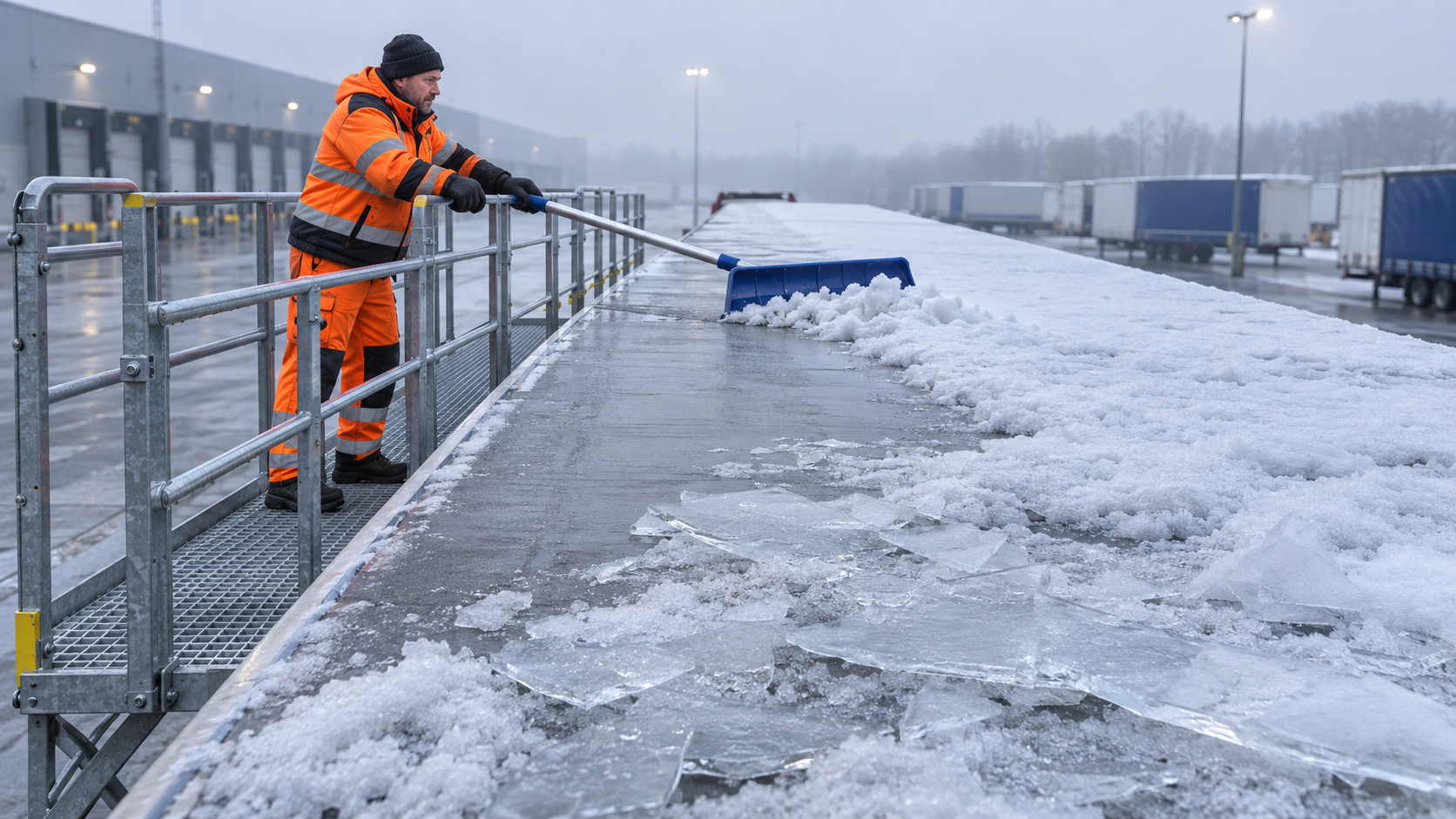
Here one must distinguish: That the roof and tarpaulin may not be stepped on is a justified safety instruction. However, this does not mean that they cannot be cleared. BG Verkehr describes, among other things, clearing scaffolding and suitable ladders secured against slipping and tipping over with appropriate clearing tools. The required equipment must be provided by the company. This can be read in the Flyer “Down with Snow and Ice” from BG Verkehr .
This exact distinction is missing in many discussions: Occupational health and safety is important. The claim that there is therefore no possibility at all to remove snow and ice is nevertheless false.
My experiences: Brilon Safety Days
I have been driving trucks for over 30 years now. I started in the mid-1990s with a 7.5-tonner in distribution traffic. Later I moved to long-haul traffic with a 7.5-tonner and a trailer combination. In 2004 I got my license for large trucks and acquired a few other qualifications.
Snow and ice on vehicle superstructures have always been a problem for me, something that had to be addressed.
They were something like a small commercial vehicle trade fair. Okay, not only that: Local forestry operations also showcased their portfolio there. This is not unusual in the Sauerland, as forestry is a significant industry here.
The last event, I believe, was in 2012. There, for the first time, I saw the RSAB, the RoofSafetyAirBag. At that time, it was still installed in a small passenger car trailer with a tarpaulin structure. Somehow, no one back then really knew what to do with it. Neither did I. However, I couldn’t ask anyone because the stand was not manned at that moment.
Only a few years later, when I was employed by my former employer at DHL Freight, I was able to establish the connection to practice.
The RSAB was one of the first technical aids of this type that I encountered. It is mounted under the tarpaulin and, when used correctly, lifts it so that water can drain off. In this way, it acts before the formation of dangerous ice plates.
How exactly this works, I have already described in a personal contribution described.
Other tools available
Over the years, I have engaged with further tools. These include:
- AirPipe from Austria
- De-icing ladders
- TruckTollo DOZER
- Snow clearing gantries at various locations on and alongside the motorway
- Durasweeper
The systems serve different purposes: some are intended to prevent water accumulation and ice formation, while others are used for clearing. And while certain aids can be carried on the vehicle, stationary installations require a suitably equipped location.
Durasweeper: Another option?
I cannot yet say much about the Durasweeper from my own experience. I know the principle of a stationary drive-through installation from comparable systems from the USA . With the Durasweeper, a height-adjustable, rotating brush performs the clearing.
A press inquiry to the manufacturer is pending. I am still waiting for a response.
What interests me above all is whether there are already installations in Germany, how the system deals with frozen ice plates, and whether drivers can operate the installation themselves after instruction. Equally important is the question of suitability for tarpaulin roofs: In the images, mostly vehicles with box bodies are visible.
Furthermore, automation is not the same for every installation. The fact that a brush can be adjusted electrically or that a clearing process runs automatically does not mean that the entire station can operate without operating personnel. I would also like to clarify this.
Prevention and clearing: What is possible on the road
For me, the tools that are already available on the vehicle are particularly interesting, rather than those only available at the next clearing station.
The RSAB and AirPipe lift the roof tarpaulin so that a gradient is created and water can drain off. The crucial point is timely application: whoever avoids water accumulations starts before ice plates form. Such a system does not replace the pre-departure inspection anyway.
The de-icing ladder can be folded up and stored in a suitable storage box on the vehicle. No, don’t laugh: the possibility exists. The objection “It will then be stolen” initially does not change the fact that suitable equipment can be carried. Of course, it must also be properly stowed and secured.
For use, a suitable stand location and enough space to work are needed. The devices must match the structure and the respective situation. This is something different from the blanket claim that there are no tools at all.
The good news: There are funding options
The question of who pays for the equipment also belongs to the equipment. Here, the companies are called upon. I have already written about funding options in the blog several times: the former De-minimis programme is now called Environmental protection and safety .
The conditions depend on the respective funding period. For 2026, the priority principle applied: what mattered was the order of the complete applications. In common parlance: Whoever comes first, gets milled first. The regular application period ran from April 14 to August 31, 2026. The details are in the official documents for the 2026 funding period .
Whether such temporal and financial limits help road safety can be debated. I would at least wish that companies use the funding opportunities specifically for aids that make the drivers’ work easier and help avoid dangerous roof loads.
Which specific purchase is eligible for funding and which conditions apply must be checked based on the respective current conditions. A funding for every system mentioned here cannot be derived from this in general. More about this you will find in my linked contribution on the funding program.
Where there is a will, there is a way
The year 2026 is coming to an end. For me, it remains incomprehensible why the discussion so often stops at excuses, even though there are various solution paths.
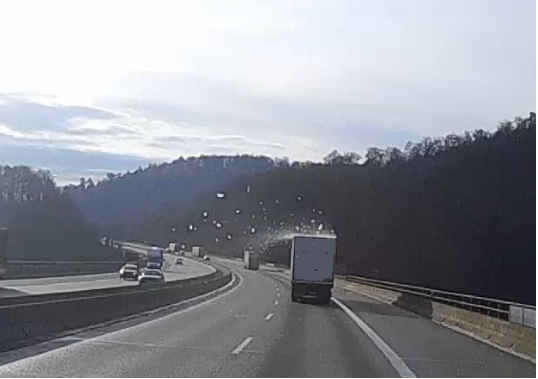
We are not talking about trifles here. Ice plates can fly far and also hit other road users from the side. This is shown in this image:
That excuse doesn’t help either: Then traffic should just keep more distance!
Responsibility cannot be shifted to other road users in this way. Whoever sets off must take care of the condition of their vehicle beforehand. And whoever uses vehicles must provide their drivers with suitable working tools.
How the way can look, I show with the category Ice plates , which I have been maintaining for years.
No excuses
Even though some might prefer to throw stones at me for it, because I’m once again criticizing lorry driver truck drivers, even though I am one myself: I say and write here what I think.
The tools show that we no longer have to act as if the problem were fundamentally unsolvable. In many, partly pointless discussions, I have come to the impression that there is also a lack of willingness to engage with the available options.
Of course, there is no ultimate solution that fits every situation. Sometimes one can work at the existing parking spot, sometimes there is not enough space there. Then a safe solution on site, suitable support, or better preparation is needed. Driving off with dangerous roof loads just to reach a cleaning station first does not solve the problem.
And yes, I know that it can be difficult on a full rest area. Missing equipment and lack of working space are real problems that companies also have to deal with. But they are no proof that there are no tools or that they are fundamentally useless.
I wrote it under a comment just yesterday: I am the one who shows solutions, not the one who takes away the thinking from adult professional drivers and has to explain every single movement to them.
That would also go beyond the meaning and purpose of this site.