
For years, the Federal Republic of Germany included in the calculation of the truck toll costs that, under European law, should not have been shifted onto the transport industry. In addition to the expenses for the traffic police, this even included costs of general crime prevention.
The Higher Administrative Court of North Rhine-Westphalia in Münster made a final decision on November 26, 2026, which is likely to have far-reaching consequences for numerous further reimbursement proceedings.
Federal government fails before the Higher Administrative Court
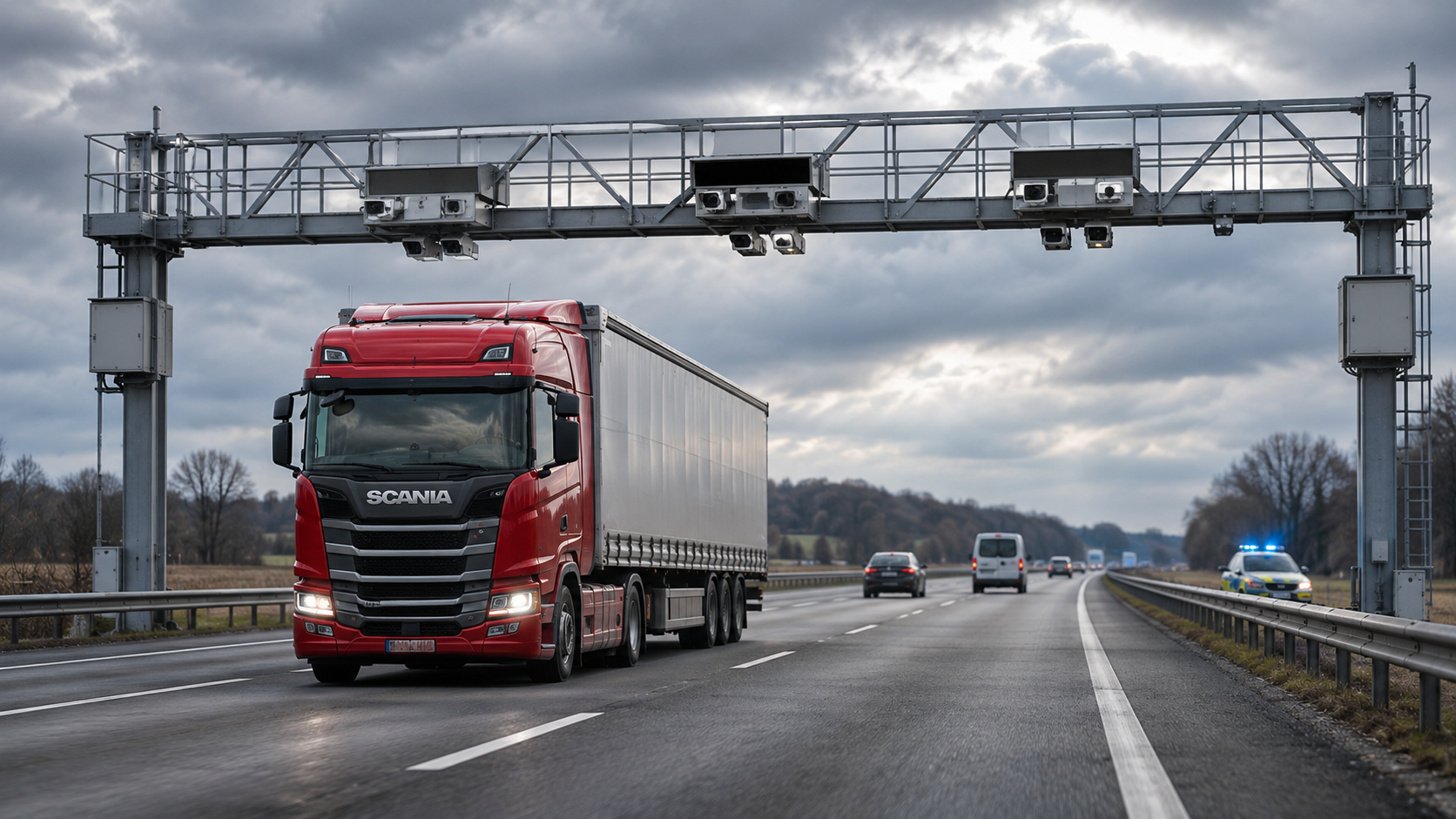
Specifically, it concerns the truck toll, which was levied between January 1, 2016, and October 27, 2020, for the use of federal motorways and federal roads.
A forwarding company sued the Federal Republic of Germany for reimbursement of truck tolls already paid. The Administrative Court of Cologne partially granted the claim and awarded the company around 20,200 euros.
Both the Federal Republic of Germany and the suing forwarding company then applied for leave to appeal. Both applications were rejected by the Higher Administrative Court.
The ruling is final. Consequently, the first-instance decision remains in force.
- Higher Administrative Court of North Rhine-Westphalia: Ruling of 26 November 2026, Case No. 9 A 974/24
- Lower court: Administrative Court of Cologne, Case No. 14 K 6556/20
What does the police have to do with the truck toll?
The European Road Infrastructure Cost Directive specifies which expenditures may be taken into account when calculating infrastructure fees for heavy goods vehicles. In particular, this includes costs for the construction, operation, maintenance, and expansion of the road network.
In contrast, the traffic police perform sovereign tasks of the state. During traffic checks, accident recording, or enforcement of the Road Traffic Regulations, the state does not act merely as an operator of transport infrastructure.
This distinction is crucial.
According to the court’s findings, the allocated police costs also included expenditures for general crime prevention. A sufficient separation between these activities and actual traffic supervision could not be established based on the underlying expert reports.
Thus, state tasks were also co-financed via the truck toll that are not directly attributable to the operation of the tollable road network.
How much toll was collected unlawfully?
The Higher Administrative Court confirmed the cost shares determined by the Administrative Court of Cologne.
| Period | Unlawful share of the infrastructure toll rate |
|---|---|
| 01.01.2016 – 31.12.2018 | 5.86 % |
| 01.01.2019 – 27.10.2020 | 4.44 % |
Important here is the distinction between the entire truck toll and the infrastructure toll rate contained therein. The stated percentages refer exclusively to the infrastructure share.
A transport company that, for example, paid a total of 500,000 euros in infrastructure tolls alone during the period from 2016 to 2018 would have incurred 29,300 euros in police costs that were impermissibly taken into account.
With larger fleets, correspondingly substantial amounts can accumulate.
Whether and to what extent these amounts can actually be reclaimed, however, depends on the respective legal and procedural prerequisites.
The problem has been known since 2020
The decision from Münster is not surprising. As early as 28 October 2020, the Court of Justice of the European Union ruled in case C-321/19 that the costs of the traffic police were not permitted to be included in the toll calculation at that time as operating costs for road infrastructure.
The starting point was the lawsuit filed by a Polish transport company that had challenged the amount of the truck toll paid in Germany for the years 2010 and 2011.
The Court of Justice of the European Union also made it clear that toll payers can directly invoke the provisions of the European road cost directive under the appropriate conditions.
With the current decision, the Higher Administrative Court also applied this legal assessment to the version of the road cost directive applicable to the period from 2016 to 2020.
The court did not consider a renewed referral to the Court of Justice of the European Union to be necessary.
Even the approval of the European Commission did not help the federal government.
The European Commission had still approved the inclusion of traffic police costs in the German toll calculation in statements from the years 2014 and 2019.
However, the Federal Republic could not successfully rely on this in court.
The authoritative interpretation of European law lies with the Court of Justice of the European Union. A deviating assessment by the European Commission does not bind national courts.
Thus, the Commission’s approval could not justify the erroneous toll calculation.
As early as 2021, there were already 35,800 refund applications pending.
How large the financial impact on the federal budget could be can so far not be conclusively quantified.
However, a parliamentary inquiry from the year 2021 provides an indication of the magnitude.
On 19 July 2021, the German Bundestag published information from a response by the federal government to a small inquiry by the FDP parliamentary group (Drucksache 19/30872).
Accordingly, around 35,800 refund applications from companies in the transport and logistics sector had already been received by the Federal Office of Goods Transport at that time.
At that time, the Federal Government could not name a total sum, as the applications had to be recorded electronically first.
More than five years have passed in the meantime. Given the current court decision, it would be of particular interest to know how many of these applications were finally processed, which amounts were repaid, and how many proceedings are still pending.
At the Administrative Court of Cologne, numerous comparable proceedings are still pending.
No impact on today’s toll rates
Anyone hoping for a reduction in the current truck toll in light of the decision will likely be disappointed.
As of October 28, 2020, the calculation of the infrastructure toll was corrected retroactively. The corresponding legal adjustment came into force on October 1, 2021.
A separate refund procedure was established for the period from October 28, 2020 to September 30, 2021.
The toll rates adjusted since then for the relevant police costs are not affected by the current decision of the Higher Administrative Court.
Can transport companies still claim money back?
The resolution does not result in an automatic right to payment for all companies that paid the truck toll during the relevant period.
In particular, the question of the limitation period plays a role. Also, already issued decisions and their legal force can be of significance.
Companies that asserted their claims in due time at the time and whose proceedings have not yet been concluded are likely to benefit most from the current decision.
Whether restitution claims for the period from 2016 to 2020 can still be asserted for the first time today must be examined in each individual case.
The Federal Office for Logistics and Mobility (BALM) is responsible for processing corresponding restitution applications.
Who actually controls the federal toll calculation?
Transport companies are expected to pay the correct amount for every tollable kilometre driven. Anyone who pays too little toll must expect a subsequent collection and, if applicable, a fine.
The question of what consequences it has when the state itself collects too much toll over several years is therefore all the more justified.
Especially in an industry where low profit margins are frequently worked with, several tens of thousands of euros are by no means a small amount. This money was not available to the affected companies over the years for investments, vehicle acquisitions, or paying their employees.
In addition comes the effort that companies had to undertake to get their money back.
That the amount of a state-imposed fee can be reviewed in court is self-evident. Less self-evident should it be that companies have to conduct proceedings for years to get illegally collected amounts refunded.
In my view, it is therefore time for the federal government to disclose which revenues were generated by the faulty toll calculation, how much of it has already been refunded, and how the still open refund claims are to be dealt with.
Anyone who demands compliance with legal provisions from others must also be held to account themselves.
Open questions for the federal government
The decision raises the following questions in particular for the Federal Ministry of Transport and the Federal Office for Logistics and Mobility:
- How high were the total toll amounts collected unlawfully between 2016 and 2020?
- How many refund applications have been submitted in total since the ECJ ruling?
- How many of these applications were approved, rejected, or are still pending?
- Which amounts have been repaid so far, including any interest?
- What options exist for companies that have not yet submitted a refund application?
- Does the Federal Government intend to close pending cases without further legal proceedings after the current decision?
- What control mechanisms have been introduced to prevent similar errors in future road cost assessments?
ChristiansBlog.eu will follow the further development and report on new findings.
Sources and further information
- Beck aktuell – Trucking companies do not have to pay for traffic police, 26.11.2026
- Recht & Politik – Truck toll was partially contrary to European law between 2016 and 2020
- Court of Justice of the European Union – Judgment of 28.10.2020, C-321/19
- German Bundestag – 35,800 refund applications due to erroneous truck toll
- Federal Highway Toll Act – § 4 Toll collection and refund of toll
- Toll Collect – ECJ ruling on the truck toll
As of: 27 November 2026. The full ruling of the Higher Administrative Court was not yet available to the editorial team when this article was created.