

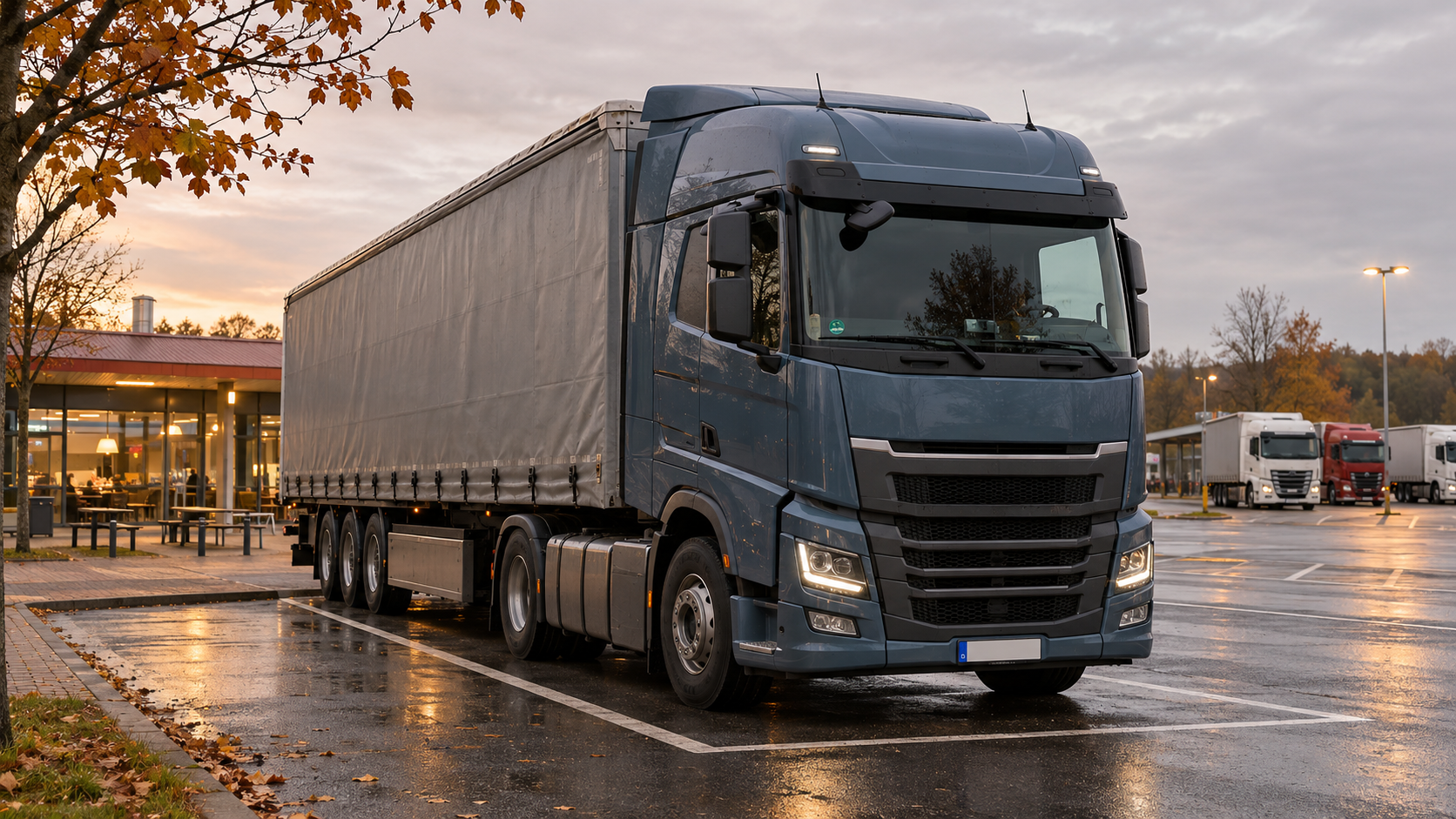
For anyone who was already asking where the next rest stop was during the last long article: make it a large coffee this time.
Drivers carrying dangerous goods in January will be among the first to notice what changes in 2027. July brings an important deadline for digital data exchange during roadside checks. In November, a new EU driving licence rule is due to apply to certain vans weighing up to 4.25 tonnes. For drivers of heavy articulated lorries, many familiar rules will remain in place. When it comes to diesel prices and permitted weights, however, it is worth checking how far the legislative process has actually progressed.
Research current as of 21 November 2026.
What is confirmed for 2027
The minimum wage rises on 1 January
From the first shift of the new year, the statutory minimum wage for employed lorry drivers in Germany will increase. From 1 January 2027, it will be €14.60 gross per hour, up from €13.90 in 2026. The 70-cent increase has already been approved. Anyone already earning more than €14.60 an hour under a collective agreement or employment contract is not entitled to a pay rise solely because the minimum wage increases. Fifth Minimum Wage Adjustment Ordinance
Pay calculations must reflect the work performed. Besides driving, this includes tasks such as loading, unloading and securing the load when the driver carries them out. Businesses in the freight forwarding, transport and logistics sector are generally subject to the record-keeping requirements of Germany’s Minimum Wage Act. Minimum Wage Act, sections 1 and 17 · Section 2a of the Act to Combat Undeclared Work
ADR 2027 applies from January
On 1 January 2027, Annexes A and B to the international agreement on the carriage of dangerous goods by road, ADR, will change. Under the general transitional provision in subsection 1.6.1.1, carriage may generally continue under the previous rules until 30 June 2027. Individual provisions have their own transitional periods. For a particular load, the relevant entry and its special provisions therefore need to be checked. German advance translation from the Federal Ministry of Transport · UNECE amendment texts
One focus is lithium-ion, sodium-ion and hybrid batteries, including batteries installed in cargo transport units. This is relevant, for example, when transporting stationary battery storage systems in containers. Other changes concern hydrogen transport, certain vehicle requirements and the use of recycled plastics in selected types of packaging. In practice, classification, packaging, marking and the transport document must all match. Anyone collecting a battery storage system, for example, should have the documentation for that specific shipment. Whether the battery is packaged separately, fitted in equipment or installed in a container can determine which provisions apply. UNECE on the ADR amendment package · UN depositary notification
A new edition of ADR does not reset the validity period of a driver’s training certificate. The expiry date on the card remains decisive. At the loading bay and during checks, what matters is which version of the rules the particular shipment was prepared under and which transitional provision applies. ADR, Chapters 1.6 and 8.2
The next driving licence exchange deadline falls in January
In Germany, photocard driving licences issued from 2002 to 2004 inclusive generally have to be exchanged by 19 January 2027. Anyone born before 1953 has until 19 January 2033, regardless of the year of issue. This mandatory exchange concerns the document itself. Separate deadlines and evidence requirements apply when renewing a time-limited lorry entitlement. Professional drivers therefore need to keep track of several dates: the year their licence card was issued, the expiry of their lorry entitlement and the expiry of their driver qualification card. Annex 8e FeV · Section 24 FeV · Section 7 BKrFQG
Road traffic rules and penalties for e-scooters change in March
On 1 March 2027, the road traffic provisions of the already promulgated e-scooter reform enter into force. The legislation incorporates the conduct rules for small electric vehicles into Germany’s Road Traffic Regulations (StVO) and brings them closer to the rules for cycling. Changes cover the use of cycling infrastructure, traffic lights and signs. For lorries over 3.5 tonnes, section 9(6) StVO is expressly extended: in built-up areas, drivers turning right must also travel at walking pace if e-scooters going straight ahead can be expected on or alongside the carriageway. Overtaking restrictions depend on the sign. Sign 277 expressly excludes overtaking small electric vehicles from its prohibition. Sign 277.1 also prohibits multi-track motor vehicles from overtaking these vehicles. The schedule of fines is being adapted to the new and reassigned offences. This reform does not introduce a general increase in standard lorry penalties for speeding, following too closely or overloading. Federal Law Gazette 2026 I No. 32, Articles 2–5 · German schedule of fines
Authorities must accept digital freight information from July
On 9 July 2027, the EU Regulation on electronic freight transport information becomes fully applicable. Authorities in EU Member States must accept information covered by the Regulation electronically when businesses make it available through a certified eFTI platform. During a check, the operator can provide access to the information for the particular transport operation using a unique electronic reference. The legal change concerns the authorities’ obligation to accept the information. Businesses generally retain the choice between paper and eFTI-compliant electronic provision. European Commission eFTI timetable · Regulation (EU) 2020/1056, particularly Articles 4 and 5
For drivers, the practical question is how the reference for the current journey will be available during a check. A photograph of the consignment note on a phone does not, by itself, meet the requirements for a certified platform. The electronic CMR consignment note and eFTI also serve different purposes. The eCMR documents the contract of carriage; eFTI governs electronic access to legally required information for authorities. Depending on the journey, further documents may still be needed. EU eFTI Regulation · UN Additional Protocol on the electronic CMR consignment note
Category B is due to cover more alternatively powered vans from November
The new EU Driving Licence Directive has been adopted. Member States must apply its first provisions relevant to goods transport from 26 November 2027. After two years of holding category B, drivers are to be allowed to drive certain alternatively powered, appropriately type-approved motor vehicles weighing more than 3.5 tonnes and up to 4.25 tonnes. For a trailer behind such a vehicle, the Directive requires category B holders to complete additional training or a test under national rules, with the combination’s maximum authorised mass not exceeding five tonnes. Category BE holders are covered by a separate rule after two years for corresponding towing vehicles with category O1 or O2 trailers. Germany still has to transpose these provisions into national law. Directive (EU) 2025/2205, Articles 6, 9 and 29
A narrower rule already exists in Germany. Section 6(3b) of the Driving Licence Regulations (FeV) allows category B holders, after two years, to drive certain alternatively powered goods vehicles up to 4.25 tonnes without a trailer within Germany. The extra weight must be attributable to the propulsion system, and load capacity must not exceed that of the corresponding conventional vehicle. Categories C and CE remain relevant for heavy lorries. Accompanied driving under the new EU Directive is scheduled to apply in November 2028. Most other provisions follow in November 2029. The digital driving licence has its own timetable, linked to the technical implementing acts. Section 6 FeV · EU Driving Licence Directive, Articles 5, 17 and 29
The lorry charging network is due to expand by year-end
The EU Alternative Fuels Infrastructure Regulation sets Member States a deadline of 31 December 2027. Publicly accessible charging pools for heavy-duty vehicles are to be available in both directions along at least half the length of the trans-European transport network, TEN-T. For the charging pools concerned on the core network, the Regulation generally specifies a total power output of 2,800 kilowatts and at least two charging points of at least 350 kilowatts each. On the comprehensive network, the corresponding requirements are generally 1,400 kilowatts and at least one 350-kilowatt charging point. At safe and secure parking areas, at least two publicly accessible lorry charging stations of 100 kilowatts each are generally required. These are infrastructure rollout requirements for Member States. The charging power and parking space actually available on a particular journey depend on the facilities on the ground. AFIR, Article 4
Rules already in force in 2026 that remain part of drivers’ daily work
Longer lorries: type 1 can now travel in Berlin
Amended rules for vehicles and combinations exceeding the standard length have applied since 21 November 2026. The provisions previously due to expire at the end of 2026 for a type 1 longer lorry – an articulated vehicle consisting of a tractor unit and semi-trailer – together with the related dimensions and technical requirements, now remain applicable until 31 December 2033. This extends specific provisions; it is not a new general authorisation for every type of longer lorry until 2033. Fourteenth Amending Ordinance, Federal Law Gazette 2026 I No. 345 · Section 13 LKWÜberlStVAusnV
The previous exclusion of Berlin has also been removed for type 1 longer lorries: these articulated vehicles may now, in principle, use the entire road network of every German state. This does not give every longer-lorry configuration unrestricted access. For the other combinations listed in the Ordinance, the approved network specified in its Annex generally remains decisive; the Annex was also replaced by the amending Ordinance. Traffic signs, clearances, weight limits and other route-specific restrictions continue to apply. Section 2 LKWÜberlStVAusnV · Comparison of the amendments
There is also a new limited exception for a type 1 longer lorry with a two-axle tractor unit. It may be up to 18.41 metres long where the additional length results solely from an elongated cab meeting the relevant EU requirements. The longer cab must not increase the vehicle’s load capacity. Otherwise, the vehicles covered by section 4(1) remain limited to 17.88 metres; other longer-lorry combinations may measure up to 24 or 25.25 metres under the subsequent subsections. Section 4 LKWÜberlStVAusnV
Turning, assistance systems and vehicle inspections
Drivers of motor vehicles with a maximum authorised mass above 3.5 tonnes already have to travel at walking pace when turning right in built-up areas if cyclists going straight ahead can be expected on or alongside the carriageway, or pedestrians may cross in the immediate turning area. Another existing rule requires a vehicle’s mandatory advanced emergency braking system to remain switched on above 30 km/h. It applies to motor vehicles with a maximum authorised mass above 3.5 tonnes and has narrowly defined exceptions. Section 9 StVO · Section 23 StVO
The provisions reviewed as of the research date do not establish a general change to Germany’s main roadworthiness inspections or safety inspections for heavy lorries in 2027. The intervals continue to depend on the vehicle type, maximum authorised mass and, where relevant, age. Sections 32 and 34 of the Road Traffic Licensing Regulations (StVZO) continue to govern dimensions and weights in Germany. Annex VIII StVZO · Section 32 StVZO · Section 34 StVZO
The driving-time rules for vans have applied since July 2026
Since 1 July 2026, EU social rules generally also apply to international goods transport and cabotage using vehicles or combinations with a maximum authorised mass above 2.5 tonnes and up to 3.5 tonnes. A trailer counts towards that threshold. Where the rules apply, a second-generation smart tachograph is also required. One exception covers certain own-account journeys in this weight range when driving is not the driver’s main activity. National rules must also be considered for transport solely within Germany. Germany’s driving personnel regulations generally already cover goods vehicles and combinations above 2.8 tonnes and up to 3.5 tonnes. EU driving and rest time Regulation · European Commission tachograph deadlines · Section 1 FPersV
For heavy lorries, the general daily driving limit remains nine hours, extendable to ten hours twice a week, with a driving break of normally 45 minutes after no more than four and a half hours at the wheel. The limits are 56 hours of driving in one week and 90 hours in two consecutive weeks. Regular weekly rest must not be taken in the vehicle. Since the end of 2024, the period for which records must be available during EU roadside checks has covered the current day and the preceding 56 days. No general revision of these requirements has been promulgated for the start of 2027. Regulation (EC) No. 561/2006, Articles 6–8 · Regulation (EU) No. 165/2014, Article 36, as amended
Professional driver qualification and periodic training
The legislature already made changes to professional driver qualification in 2026. Under the new rules, the IHK examination for accelerated initial qualification can be taken in nine languages in addition to German, including Polish, Romanian and Ukrainian. For periodic training, current law also permits digital teaching formats under certain conditions. The training provider must be recognised and the relevant teaching must meet the statutory requirements. The normal five-year cycle with 35 teaching units continues to apply. Driving licences and driver qualification cards each have their own expiry dates. Amending Ordinance, Federal Law Gazette 2026 I No. 236 · Section 2 BKrFQV · Section 4 BKrFQV · Section 5 BKrFQG
German lorry tolls continue under the existing rules
Germany’s lorry toll has differentiated by CO₂ emissions since December 2023. Since July 2024, the toll has generally applied to vehicles intended or used for goods transport with a technically permissible maximum laden mass above 3.5 tonnes. For a combination, the motor vehicle determines whether this threshold is exceeded. Factors affecting the rate include the CO₂ emissions class, pollutant emissions class, technically permissible maximum laden mass and, for vehicles above 18 tonnes, the number of axles. The already adopted toll exemption for zero-emission heavy-duty vehicles runs until 30 June 2031. For zero-emission vehicles up to 4.25 tonnes technically permissible maximum laden mass, the law provides an exemption without this time limit. Federal Trunk Road Toll Act, section 1 and Annex 1 · Toll Collect tariff table
Nevertheless, the rate for an individual vehicle may change in 2027. Under the existing procedure, vehicles in CO₂ classes 2 and 3 are reassessed six years after first registration and every six years thereafter. For relevant vehicles first registered in 2021, that reassessment may fall due in 2027. Toll Collect also published revised thresholds for classifying affected heavy-duty vehicles from 1 July 2026. A higher charge can therefore result from the classification of the particular towing vehicle, even without a change to the tariff table at the turn of the year. Toll Collect on CO₂ emissions classes · Toll Collect on thresholds from July 2026
Proposals still under negotiation, or with later application dates
EU carbon pricing starts in 2028; Germany’s bridging arrangement is still in the legislative process
The EU has legally postponed the start of emissions trading for buildings, road transport and additional sectors, known as ETS 2, until 2028. Germany’s national fuel emissions trading system therefore remains relevant in 2027. On 15 October 2026, the Bundestag voted to extend the 2026 auction price corridor of €55 to €65 per tonne of CO₂ into 2027. As of the research date, 15 November, the legislation was still before the Bundesrat. The published document gives 20 November 2026 as the deadline. The corridor concerns the auctioning of allowances to businesses placing fuels on the market. The price of diesel on any particular day also depends on oil markets, taxes and the price at the individual filling station. EU Regulation 2026/667, Article 2 · Bundestag legislation, Bundesrat document 624/26
A separate issue is the CO₂ fleet targets for manufacturers of new heavy-duty vehicles. The Commission is due to review the EU rules in 2027 and report on their effects by year-end. Fleet requirements influence the vehicles available to buy. They do not introduce a general ban on existing diesel lorries in 2027. Euro 7 also has its own timetable: 29 November 2027 concerns new passenger car and light commercial vehicle types in categories M1 and N1. For heavy lorries in categories N2 and N3, Euro 7 generally starts on 29 May 2028 for new types and 29 May 2029 for new vehicles. EU Regulation on CO₂ fleet targets · Euro 7 Regulation, Article 20
The 44-tonne debate for zero-emission powertrains: separate from combined transport
The 44-tonne debate referred to here concerns higher weight limits for lorries with non-fossil propulsion – more precisely in legal terms, zero-emission technology such as batteries or fuel cells. It does not refer to the existing 44-tonne rule for certain combined or intermodal transport operations. That rule is not new for 2027 and, where its conditions are met, can also apply to diesel lorries. Merely describing a fuel as alternative or non-fossil does not make a lorry a zero-emission vehicle.
For many vehicle combinations with more than four axles, the German weight limit under section 34 StVZO is 40 tonnes. For certain intermodal operations carrying containers or swap bodies, 42 or 44 tonnes are already permitted, depending on the axle configuration. Subject to the statutory conditions, extra weight attributable to the propulsion system can be allowed: up to one tonne for alternative-fuel technology and up to two tonnes for zero-emission technology. Axle loads and the permitted values for the particular vehicle remain decisive when loading. Section 34 StVZO, particularly subsections 5b, 6 and 6a · Existing combined transport exception, section 1 of the 53rd StVZO Exemption Ordinance
At EU level, the Council and Parliament are negotiating a reform of Directive 96/53/EC. Among other things, it concerns weight limits in international transport, additional allowances for zero-emission powertrains and intermodal operations. The potential new rules for zero-emission powertrains discussed here must be distinguished from the existing exceptions for combined transport. This does not mean a blanket 44-tonne limit for all lorries from 2027; as of the research date, a corresponding new rule for zero-emission lorries from 2027 had not been definitively adopted either. The limits under discussion depend on factors including axle configuration and the type of transport operation. Even if an agreement is reached, the final conditions and application dates will be decisive. For the next load, what counts is the vehicle documentation, the applicable axle and gross weight limits, and any restrictions along the route. EU legislative procedure 2023/0265(COD) · Council negotiating document of 30 September 2026
For drivers, the most important date in 2027 therefore depends on their work. For dangerous goods transport, the changeover begins in January. For drivers with an older licence card, 19 January may already be a key deadline. Those who regularly present freight information during roadside checks are most likely to notice the change from July, once their own operator starts providing it digitally.