

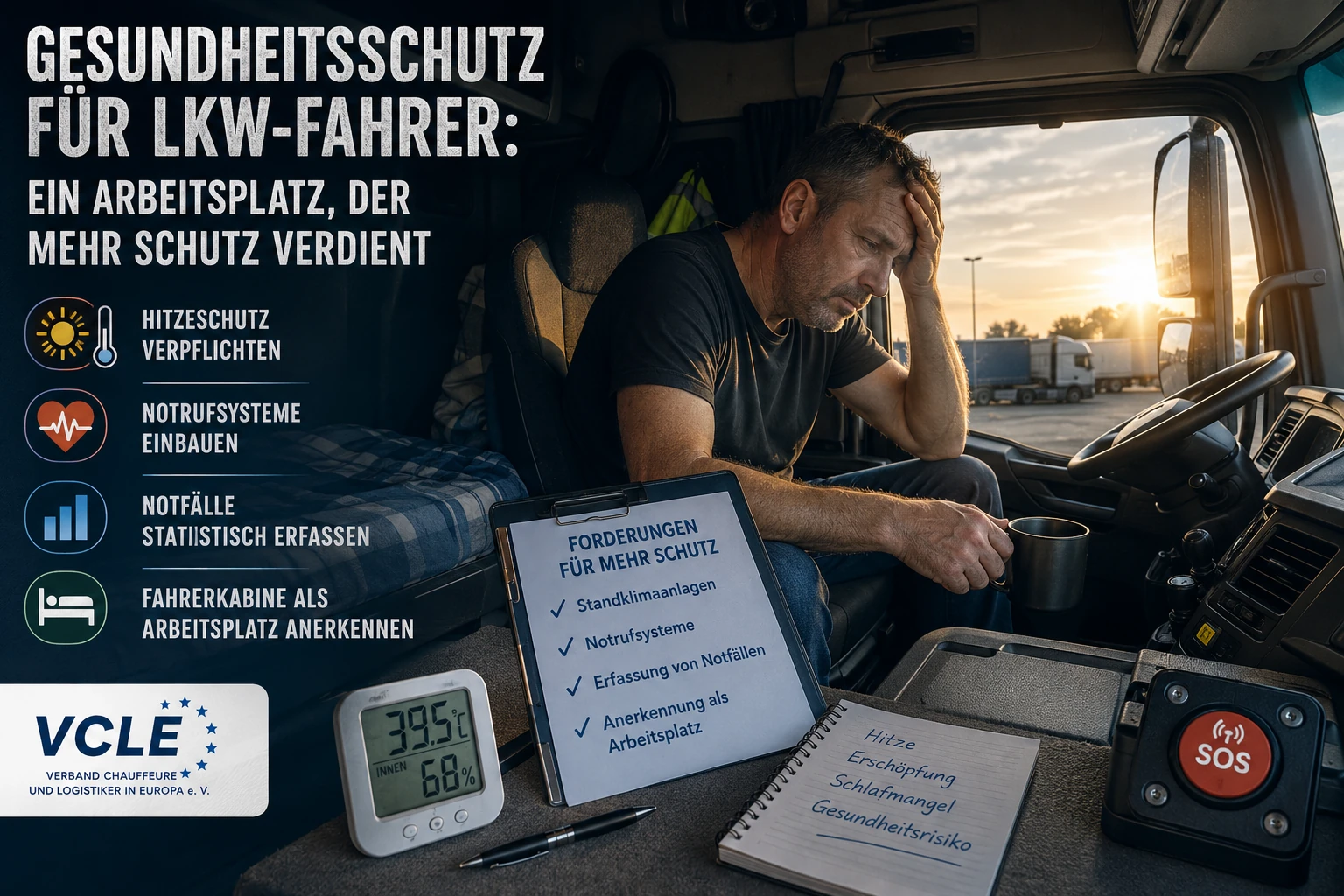
The Association of Drivers and Logistics Professionals in Europe (VCLE) recently put forward a set of proposals that look at first like a collection of separate measures. They include making parking air conditioning and emergency alert systems mandatory, recording medical emergencies across Europe and recognising the driver’s cab as a workplace.
Look more closely and a broader question emerges:
Why have measures that improve health and safety been subsidised for years while fitting them remains optional?
A debate that’s been going on for years
Regular readers will know that the debate about parking air conditioning goes back years.
I started asking long ago why vehicles with sleeper cabs weren’t required to have air conditioning that works while parked. Other pieces followed, including ‘Parking air conditioning must become mandatory’ and Parking air conditioning in lorries… .
The arguments haven’t changed much.
Drivers often take their rest at service areas with no shade. Lorry cabs can get extremely hot in summer. The result is poor sleep, physical strain and less recovery during the rest periods required by law.
Fitting parking air conditioning is still optional.
From comfort to occupational health
For a long time, parking air conditioning was discussed as a matter of comfort.
Anyone who’s climbed back behind the wheel after a sweltering night in a hot cab knows there’s much more to it.
Poor sleep affects concentration. Heat stress puts strain on the cardiovascular system. Fatigue increases the risk of accidents.
Other industries would have called this a workplace health and safety issue long ago.
In road haulage, that change is only gradually taking hold.
Even BG Verkehr, Germany’s transport-sector accident insurance institution, now describes heating and air conditioning independent of the vehicle’s engine as the current state of the art for cabs with bunks.
The problem is well established.
The question is why the solution is still optional.
Health is about more than temperature
The VCLE’s proposals go beyond parking air conditioning.
The association also wants alerts for medical emergencies and Europe-wide records of these incidents.
That might sound surprising at first. Automatic emergency calls have been around for a long time in road transport.
The VCLE is drawing attention to situations different from a typical road accident.
What happens if a driver has a heart attack or stroke during a rest break at a service area?
What if they need medical help while alone in the cab at night and can no longer call for it themselves?
These cases rarely get public attention. They’re recorded in statistics even less often.
That’s why the VCLE wants better data alongside technical solutions. Policymakers can only take account of problems they can see.
Taking the idea further
I think the debate could go further still.
The technology is already here. Some manufacturers offer assistance systems that can tell when a driver stops responding. The vehicle warns the driver first and can then come to a controlled stop. VW already offers this as Emergency Assist.
I asked about this very thing at the IAA years ago.
The new Active Brake Assist 5 was being unveiled at the time. I wanted to know how it worked and spoke to someone from Daimler. He explained that the lorry could already stay in its lane for a while, even if the driver let go of the wheel.
So I asked a simple question.
What happens when that time runs out and the driver still isn’t responding because of a medical emergency?
I wondered then whether the vehicle ought to slow down on its own, steer to a safe place to stop and call for help automatically.
The answer was sobering.
No, the lorry wouldn’t do that.
I pointed out that a 40-tonne lorry carrying on without an alert driver could be a serious danger to other road users. I got no further explanation.
That question is more relevant than ever. If vehicles can already tell when a driver stops responding, why aren’t we discussing how a heavy goods vehicle could come to as safe a stop as possible in that situation?
In a medical emergency at the wheel of a lorry, such a system could protect the driver’s life and prevent serious accidents.
Subsidising safety equipment
This is where the debate gets particularly interesting.
The ‘Environmental Protection and Safety’ funding scheme has subsidised measures to improve safety and working conditions in road haulage for years.
They include cab equipment, safety systems and other measures that go beyond the minimum legal requirements.
There’s a simple rule:
Equipment already required by law is generally ineligible for funding.
It follows that as long as parking air conditioning still qualifies for funding, it’s optional equipment.
This creates a contradiction.
The state acknowledges that certain systems are worth having and helps pay for them with taxpayers’ money. Fitting them remains optional.
The same pattern elsewhere
You can see this pattern elsewhere.
One example is equipment to prevent sheets of ice forming on semi-trailers.
The danger has been known for years. Serious accidents keep happening when ice comes loose from vehicle roofs on the move. Solutions exist, and some qualify for funding.
There’s still no universal requirement to fit such systems.
The same goes for many other safety and protective measures:
- The problem is known.
- A technical solution exists.
- There is funding to buy it.
- Fitting it remains optional.
That’s why the VCLE’s proposals reach well beyond individual items of equipment.
The link with the driver shortage
At first glance, the VCLE’s proposals might look like a debate about equipment.
They touch on a much bigger problem.
I recently argued in my editorial ‘The driver shortage is a symptom of an industry under pressure’ that the causes run much deeper than a shortage of licence holders or recruitment schemes. Read more: The driver shortage is about more than recruitment…
Pay is only one reason people rule out a job.
They also turn it down because of the working conditions.
Because they can’t plan their lives around it.
Because it takes them away from their families for weeks.
And because even basic questions about health and safety are still up for debate.
That’s why the VCLE’s proposals are about more than parking air conditioning or emergency alerts.
They draw attention to something that gets too little airtime in the debate over the driver shortage.
What makes a job attractive is the conditions people work in. Recruitment campaigns and lower age limits won’t create that appeal.
How much do we value drivers?
People have been talking about a driver shortage for years.
Politicians and employers discuss recruitment, licensing rules and qualifications.
What often gets overlooked is how much of their lives professional drivers spend in their vehicles.
The cab is where they drive.
It’s also where they spend their downtime, take breaks, eat and sleep.
Legally, though, it is still often treated primarily as part of a vehicle, with little recognition of its role as a workplace.
That’s where the VCLE’s proposals come in.
Once you recognise the cab as a workplace, the standards change.
The question goes beyond comfort.
It’s about protecting health.
It’s about safety at work.
It’s about the standards that should apply to the people moving Europe’s goods from A to B every day.
What that means on the road
Amid all the political debate, funding schemes and lists of demands, it’s worth remembering what’s at stake.
People live with the consequences every day.
I now drive a lorry with both a parking heater and parking air conditioning.
And yes, I’m glad I do.
After one night in the vehicle, you can feel the difference. It’s nothing to do with luxury.
If you’ve tried to sleep in a cab that’s been baking in the summer heat, you’ll know how little rest you can get during your legally required break. If you haven’t, think of a sauna. Could you sleep in one? Without anyone pouring water on the stones, of course. Just the heat.
Things weren’t better in the old days. We didn’t have this equipment then, that’s true. We didn’t sleep any better in the heat either. We were still tired when we had to get going again. Hardly a proper night’s sleep.
There are practical limits, too.
Even modern parking air conditioning can struggle when it gets well above 30°C outside. It can ease the situation, but the underlying problem remains.
That makes it all the more important to ask how drivers will spend their required rest time as heatwaves become more frequent and more intense.
The debate about occupational health and safety standards seems more important now than ever.
Conclusion
The VCLE’s proposals may look like a set of individual measures at first.
They raise a much wider issue.
For years, people have developed equipment to improve safety, protect health and make working conditions better. Many of those measures receive public funding.
As long as they are optional, adoption often comes down to goodwill or what a company thinks it can afford.
We’ve spent plenty of time debating whether parking air conditioning, emergency alerts and other protective measures are worthwhile.
Perhaps we should ask why, in 2026, equipment that can improve health and safety is still optional when we’ve long known it can protect people.
The VCLE’s proposals give us a reason to have that debate.
It’s probably long overdue. After I petitioned for the RSAB roof safety airbag, I was told that the German government didn’t consider itself responsible and that you couldn’t require every EU member state to fit one because some countries don’t get snow.
The weather may stop at ‘national borders’. Lorries don’t. Every driver, wherever they’re from, has a right to healthy, restorative sleep and to systems that keep them and other people safe.